Long Stride Ranch Renewables
What We Do

Regenerative Bio Waste Solutions
Our unique processors will be located at farms and equestrian events around the country, capturing waste and turning it into RENEWABLE FUELS and ORGANIC FERTILIZERS
Locations
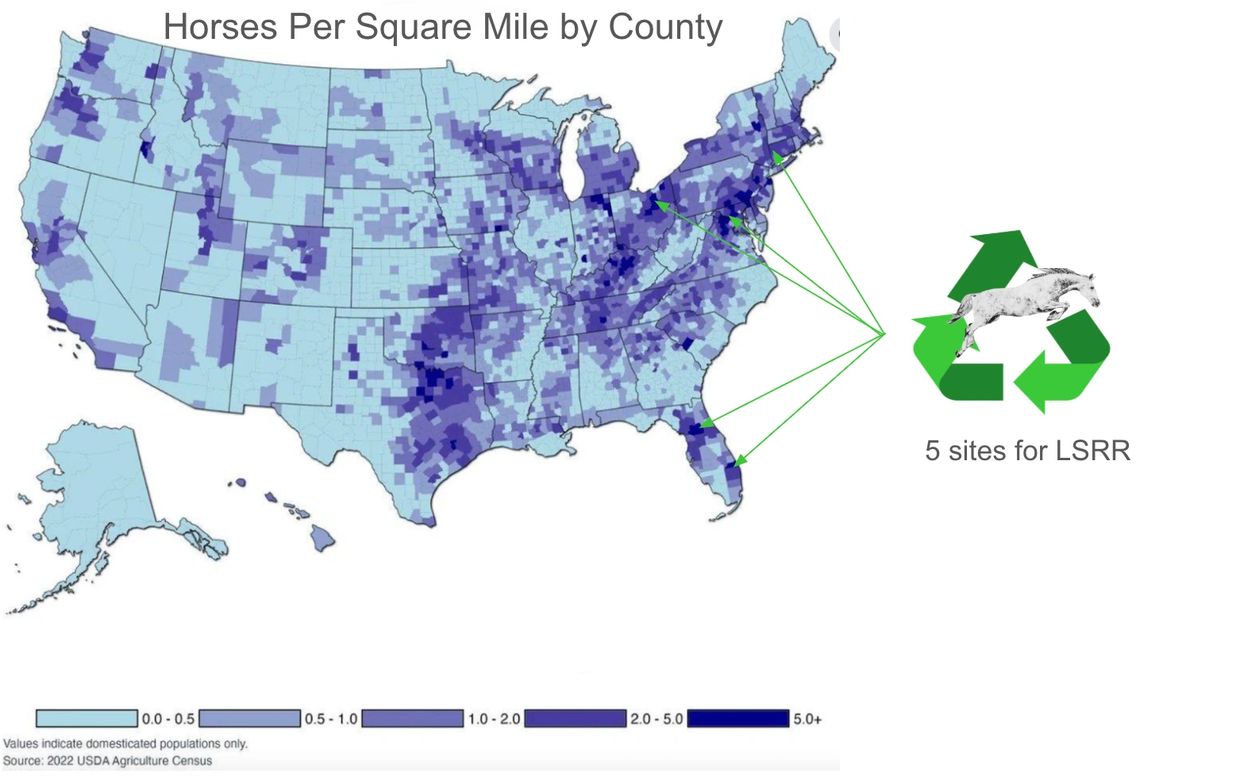
The United States is home to 7.2M+ horses. Hundreds of locations have a large concentration of stabled horses, justifying one or more units at each site
Our first location is in Palm Beach County, Florida, home to 15,000 horses and Wellington International
Permanent Units
Large venues can continuously upcycle equine waste into valuable commodities. This waste would normally be trucked to landfills or spread on fields, creating emissions and causing runoff and pollution.
Expansion
Hundreds of sites in the US have tremendous concentrations of stabled horses
Our first location is in Palm Beach County, Florida, home to 15,000 horses and Wellington International
Four additional sites targeted for expansion by 2030

How It Works
Unique Technology
We use proven pyrolysis technology with a unique system, producing Renewable Fuels and valuable agricultural products, including BioChar.
The natural process to create carbon and oil from biomass takes millions of years - our system takes just a few seconds, upcycling something that would normally be waste.
Our technology processes waste without emissions, dust or pollution.
Massive amounts of carbon are sequestered in the BioChar we produce.
The Processors

Permanent and trailer-mounted mobile units can run 24/7 or be ramped on and off.
Each unit can process all the waste from 1,000 horses/year
Producing up to $1.5M in revenue
This System Can Be Used for any Biomass Waste
Agricultural Operations
Agricultural Operations
Agricultural Operations

Breweries
Agricultural Operations
Agricultural Operations
Lumber Mills
Agricultural Operations
Storm Clean Up
Storm Clean Up
Livestock Waste
Storm Clean Up
Livestock Waste
Livestock Waste
Livestock Waste
Beach Debris
Livestock Waste
Livestock Waste
Current Practices for Stable Waste
A typical stabled horse produces more than 40 pounds of waste every day. In our town of 15,000 horses, that means 110,000 TONS of waste every year.
Horse manure is commonly spread on fields. High volumes of stabled horses produce too much waste to spread without causing runoff and pollution.
Many towns dump the waste in landfills, which causes methane emissions and uses an enormous amount of space.
Burning or incineration of equine waste causes significant air pollution.
Composting unfortunately also causes methane emissions and runoff problems, and appropriate composting facilities do not exist for most municipalities or private facilities.